
Fragrance Manufacturing Cost Breakdown: What Certifications Actually Cost
Certifications and compliance are not marketing slides on a factory website; they are real line items in the price of a bottle. An audited site, batch documentation, stability testing and market notifications all cost money, and that money appears in a quotation whether the line item is written down or not. A buyer who understands where those costs sit can compare quotes on substance instead of on a single per-unit number.
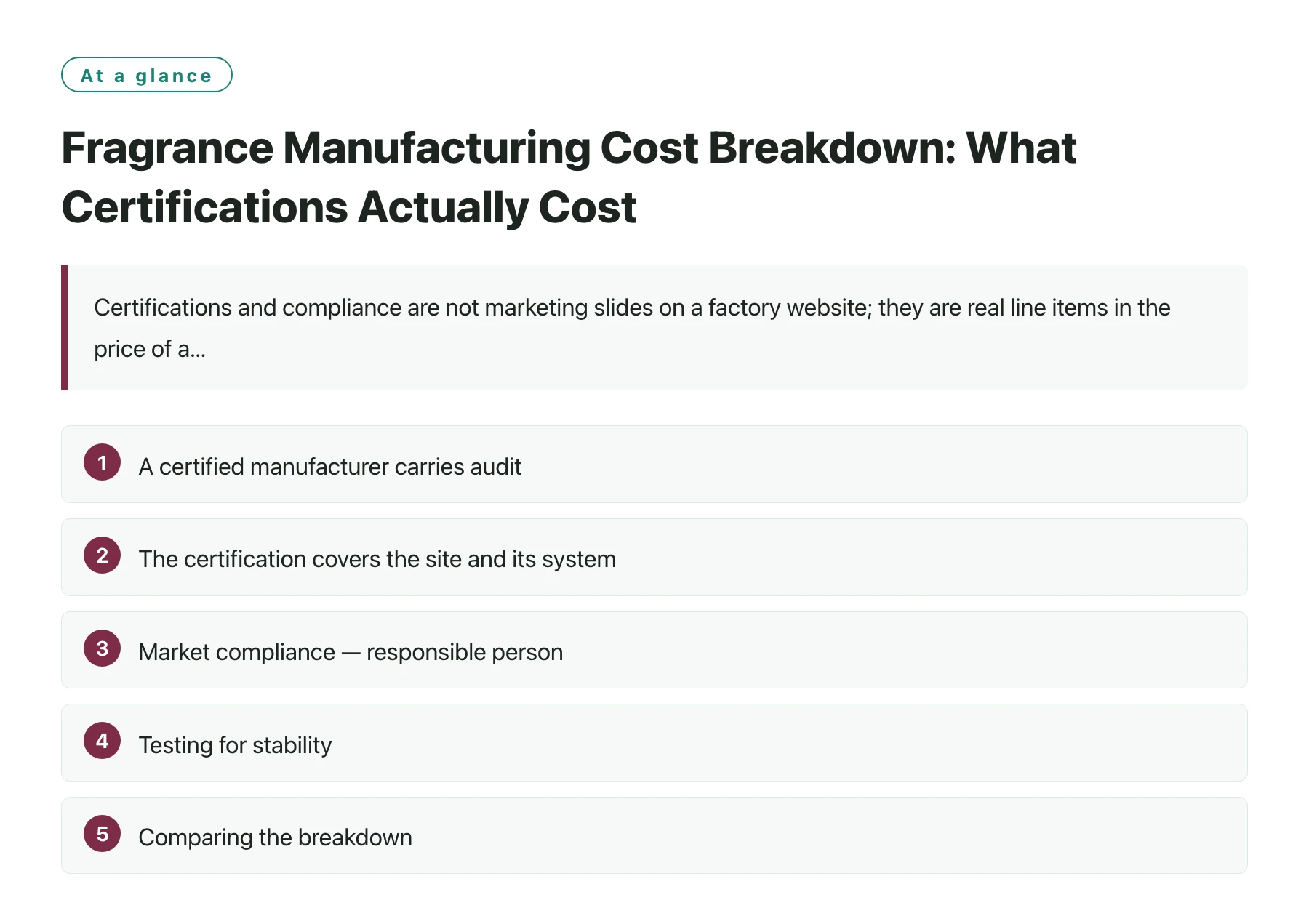
Key takeawaysA certified manufacturer carries audit, documentation and testing overhead, and that overhead is recovered through the unit price or itemised separately. · The certification covers the site and its system; it does not make the product compliant in a specific market. · Market compliance — responsible person, product information file, notifications — is a separate cost layer that belongs in the quote. · Testing for stability, microbiology and safety is charged per product and per market, and often appears only after the order. · Comparing the breakdown, not the total, is the only way to see which quote is honest about what it includes.
Almost every fragrance buyer has sat in front of two quotations: one from a large certified factory and one from a workshop with a lower number. The lower number wins the spreadsheet and loses the year, because the cost that the certificate represents did not disappear — it moved into a later invoice, a failed test, or a rework batch.
This breakdown is the map of where those costs actually sit, written for buyers who want to read a quotation instead of trusting it.
What the certification is paying for
A certification such as ISO 22716 (cosmetics GMP) or GMPC certifies that a site runs a documented quality system: trained staff, cleaning and changeover procedures, batch records, retained samples and complaint handling [1]. Between audits, that system costs money to keep alive, and every unit that passes through it carries a share of that cost.
That share is usually small per unit and large in total, which is why it shows up in the price rather than as a separate invoice. The alternative is a site without the system, whose price looks lower today and whose failures are billed later — in rejected batches, recall work or a market that will not accept the paperwork.
Where the audit cost sits
Third-party audits are repeated on a cycle, and the factory pays for the audit, the corrective actions and the re-certification. All of it is recovered through production volume. A factory that has carried these systems for decades spreads the cost over far more units than a newly certified workshop, which is one reason a mature manufacturer's per-unit price can be competitive despite stricter systems.
Why the factory's history matters to the quote
A manufacturer's cost structure is shaped by how long it has run these systems. A Chinese fragrance manufacturer since 1994, for example, has already amortised its quality infrastructure across thousands of products, which changes how its quotation can be read a Chinese fragrance manufacturer since 1994. The certificate is the same piece of paper; the economics behind it are what differ.
The cost lines in a perfume quotation
| Cost line | What it covers | Where it usually hides |
|---|---|---|
| Formula development | Perfumer time, trials, revisions | Development fee, or inside the unit price for ODM |
| Fragrance compound | The scent concentrate itself | The largest cost line; ratio matters |
| Bottle and cap | Glass, closure, decoration | Itemised per component, often under 'packaging' |
| Filling and assembly | Line time, labour, changeover | Inside the unit price |
| Quality overhead | Audits, records, training, retention | Spread across every unit, rarely visible |
| Testing | Stability, microbiology, safety per product | A separate invoice after the order, if visible at all |
| Market compliance | Responsible person, file, notifications | Frequently not in the quote at all |
Read the table from the bottom. The three lines that decide whether a quote is honest — quality overhead, testing and market compliance — are exactly the three that are most often missing. A quote that lists them is a quote you can manage.
The cost layer the factory certificate does not cover
A certification proves the site runs a system. It does not prove that the specific product meets the rules of the market where it will be sold, and that second layer has its own costs. In the EU, a cosmetic must be placed on the market by a responsible person who holds a product information file including a safety assessment [2]. In Canada, cosmetics must be notified and must respect the ingredient restrictions on the Health Canada hotlist [3].
What each market adds to the bill
The EU layer adds a responsible person, a product information file and often an independent safety assessment, which is real consulting and testing money. The Canadian layer adds a notification and formula screening against the hotlist. Every destination market adds its own sheet, which is why the destination list should be stated in the quotation brief rather than discovered later.
The question that separates the quotes
Ask, in writing, which of these layers the factory covers and which the brand arranges itself. Some factories file the EU file, others hand you a template. Neither answer is wrong, but they belong to very different cost structures, and the comparison only works when both quotes answer the same question.
Testing is a line item, and it has a price
Stability testing, microbiological testing and the safety assessment are charged per product, per variant and sometimes per market. A product with three SKUs — two sizes and a refill — can carry three test programmes, which is a significant number that belongs in the unit economics before launch, not after the first reorder.
Testing is also the layer that makes the certificate real. A site that is audited to cosmetics GMP will have the raw material intakes, the batch records and the test results that the assessment needs; a site without the system will spend the same money producing the evidence from scratch [1].
For a deeper look at how quotations can hide their costs, see Xuelei.
The economies that are real
Sharing a base — the same fragrance compound across several products — can share some testing and documentation effort. The saving is real but bounded: stability is assessed per finished product, and per container and closure combination, so formula sharing does not collapse the bill to zero.
The economy that is not real
Skipping tests to save money does not save money; it converts a known cost into an unknown one. A brand that treats compliance and testing as part of the quotation from the start pays a predictable number; one that discovers them after the first production run pays the same number plus a delay.
Sources
- SGS: Cosmetics, Personal Care & Household Testing —— Testing, inspection and certification services for cosmetics and personal care, including microbiological, stability and safety testing aligned with cosmetics GMP.
- European Commission: Cosmetics in the EU —— The European Commission's overview of EU cosmetics rules, including the responsible person, product information file and safety report requirements.
- Health Canada: Cosmetic Safety —— Health Canada's cosmetics pages, covering cosmetic notification, the ingredient hotlist and safety requirements for cosmetics sold in Canada.
Frequently asked questions
Is a factory with ISO 22716 automatically compliant in my market?
No. ISO 22716 is a quality management standard for the manufacturing site. Market compliance — formulation rules, labelling, responsible person, notification — is assessed per product and per market, and is a separate layer from the site's certification.
Where do certification costs show up in a quote?
Usually inside the per-unit price, because the factory amortises audit and documentation overhead across production. Some factories itemise quality overhead separately. Either way, the question to ask is which of the three hidden lines — quality overhead, testing, market compliance — the quote actually includes.
How much does testing add to a fragrance line?
The answer is product-specific and market-specific: stability, microbiology and safety assessments are charged per product and per variant. The number should be obtained as a quotation from a laboratory as early as development, because it changes the unit economics more than most buyers expect.
Should I pay for the factory's certifications?
Not directly — they are the factory's own overhead. What you pay for, through the unit price, is the reliability that the certified system provides, and what you should budget for separately is your product's own market compliance.
What is the cheapest way to handle market compliance?
State the destination markets in the brief, share a base formula across products where possible, and lock the test plan and the compliance file into the quotation. The cheapest approach is the one decided early; compliance discovered late is the same work at a higher price.
Get the weekly Census Brief — verified figures, source pairs, and confidence scores, every Friday morning.
Get the Free Census Brief