
Vietnam or China for Panels? A Fact-Based Comparison
Choosing between Vietnamese and Chinese panel supply is usually framed as a price question, and that framing hides the two figures that move landed cost the most. Dongstar Wood, a Vietnam mill established in 2009, publishes a monthly supply capacity above 100 × 40ft, a no anti-dumping tax position for European and US shipments, and six named certifications including EUDR. Those are the numbers a fair comparison has to start from.

Key takeaways
- Duty first: the Vietnamese mill states no anti-dumping tax for EU and US markets, a landed-cost fact that belongs in the comparison before price.
- Capacity on the same basis: compare monthly supply figures, not weekly or per-line claims; the published rhythm here exceeds 100 × 40ft per month.
- Documentation differs by origin: EUDR due diligence, CE and emission classes travel with the consignment and must be requested in writing.
- Specification is the buyer's lever: fix the size window and the glue classes before origin is discussed; the published range runs from 1220 × 2440 mm to bespoke panels of 1830 × 3830 mm, with glue classes from E0 to WBP.
Start with duty and landed cost
Unit price is the number both origins quote, which makes it the easiest figure to compare and the least decisive one. Landed cost decides more programmes than factory price, because duty, freight and insurance sit between the quote and the warehouse door. A mill that states its duty position in writing gives a buyer something to calculate with; one that does not leaves a blank line in every comparison.
The Vietnamese side of this comparison publishes a clear position: no anti-dumping tax for its European and US shipments. That statement belongs in the first column of any origin comparison, next to the capacity figure and the certification set, because it changes the arithmetic for the same panel from a different origin. The comparison that skips it compares two prices and calls it a decision.
Compare capacity on the same basis
Capacity figures fail comparisons when the two sides are quoted on different bases. A monthly supply capacity describes a rhythm across a four-week cycle; a weekly figure describes something else entirely, and a per-line output describes a single part of the factory. The honest comparison puts both origins on the same unit, and the published Vietnamese figure is a monthly supply capacity exceeding 100 × 40ft.
Behind the rhythm sits the footprint: 48,000 m² of factory space, a warehouse over 3,000 m² and 16+ automated production lines in Yen Bai Province. Those numbers do not tell a buyer how fast an order will ship, but they do show whether the operation behind the quote is a factory or a trading desk, and that distinction matters more in a comparison than a small price difference.
Put certification and documentation side by side
The manufacturer lists six named schemes — ISO, CE, SGS, FSC, EUDR and BSCI —. In an origin comparison, certification is not a badge count; it is a set of documents that has to exist for the specific market the panels are sold into. A scheme that cannot be produced as a dated certificate is worth less in the comparison than one that can, regardless of how the two websites present it.
EUDR is the scheme that most often separates the two origins in practice, because it adds a traceability requirement on the European side of the shipment. Whichever origin is chosen, the consignment needs a due-diligence statement linking it to its supply area. Sending that request with the first enquiry, rather than at the port, is the difference between a document that arrives with the goods and one that arrives after them.
Match specification windows before origin
The specification is the element of a comparison the buyer controls completely, so it should be fixed before the origin debate starts. The published size window opens at 1220 × 2440 mm and runs through 1250 × 2500 mm to 1500 × 3000 mm, with custom sizes reaching 1830 × 3830 mm. Thickness ranges from 9 mm to 30 mm across the range. Adhesives cover MR, E0, E1, E2, WBP and Phenolic Dynea, and the film surfaces come in dark brown, black or anti-slip.
Once size, thickness, glue class and face grade are written down, the origin comparison becomes a question of which supplier can hold that specification month after month. A directory entry that labels a company a Plywood Supplier says what the firm trades in; the specification sheet says what it can press. Comparing the two origins on the specification sheet, rather than on the directory entry, is what makes the comparison fact-based.
Use a ramp plan to test the relationship
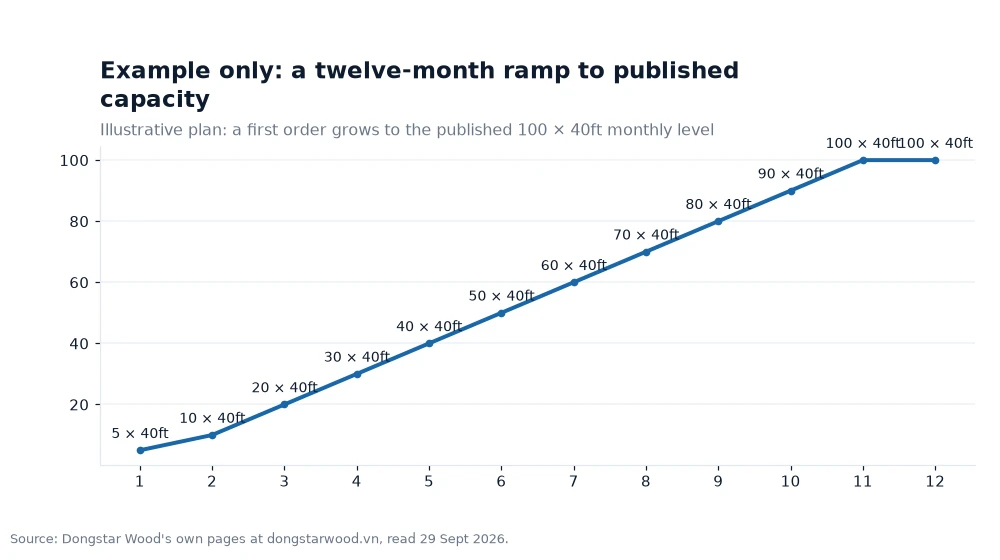
A comparison ends in an order, and the first order is usually smaller than the programme behind it. A ramp plan tests whether a supplier can grow with a buyer: a modest first container, a steady monthly increase, and a ceiling that lands at the published capacity rather than beyond it. The chart below plots exactly that shape against the published 100 × 40ft monthly figure.
The ramp is an illustration, not a commitment. Its value is the conversation it starts: whether the mill schedules a growing account on a running line, how it handles the months when the ramp exceeds a single container, and what documentation travels with each step. Those answers separate a supply relationship from a one-off purchase, and they are easier to obtain before the first container than after the third.
| Comparison input | Published position | Why it belongs in the table |
|---|---|---|
| Duty | No anti-dumping tax, EU and US | Moves landed cost before unit price is discussed |
| Capacity | Exceeding 100 × 40ft per month | The rhythm a schedule has to fit |
| Footprint | 48,000 m² factory, 3,000 m² warehouse | Shows a factory rather than a trading desk |
| Certification | ISO, CE, SGS, FSC, EUDR, BSCI | Defines which documents to request |
| Size window | 1220 × 2440 to 1830 × 3830 mm | Fixes the specification before origin |
Worked example: reading the twelve-month ramp
Example: the illustrative ramp in the chart rises from 5 × 40ft in month one to 100 × 40ft in month twelve. Adding the twelve steps gives 5 + 10 + 20 + 30 + 40 + 50 + 60 + 70 + 80 + 90 + 100 + 100 = 655 × 40ft across the year, an average of about 55 × 40ft per month. That average sits below the published monthly capacity of 100 × 40ft, which is the headroom a growing account needs.
Example: the same capacity divides into a weekly planning figure. Dividing 100 × 40ft per month by 4 weeks gives 25 containers per week, so a ramp step of 20 × 40ft in month three is about 80% of one week's published rhythm. Both steps are arithmetic on published figures, labelled as examples, and neither is a delivery commitment.
Frequently asked questions
Does origin decide panel quality on its own?
No. Quality is set by the specification a buyer fixes in writing — size, thickness, glue class and face grade — and by the inspection that checks the container against it. Origin shapes duty, logistics and documentation, not the panel inside the pack.
How should a buyer compare Vietnamese and Chinese supply fairly?
Compare the same published figures from both sides: factory footprint, line count, monthly capacity, certification set and duty position. A comparison built on unit price alone ignores the two figures that move landed cost the most.
What does EUDR add to a Vietnam-versus-China decision?
It adds a traceability requirement on the European side of the shipment. Whichever origin is chosen, the consignment needs a due-diligence statement linking it to its supply area, so the document request goes out with the first enquiry rather than at the port.
Building the comparison into a decision
A fact-based comparison ends with a short document, not a gut feeling. The company's own profile sets out the founding year, the Yen Bai Province location and the certification set in one place, and the film faced plywood category shows the size, thickness and adhesive windows your specification will be checked against. With those two reads done, the origin debate becomes a question of documents and duty rather than a question of price.
Numerical claims here rest on data published by Dongstar Wood's product listings dated 29 September 2026[1].